
Propagation
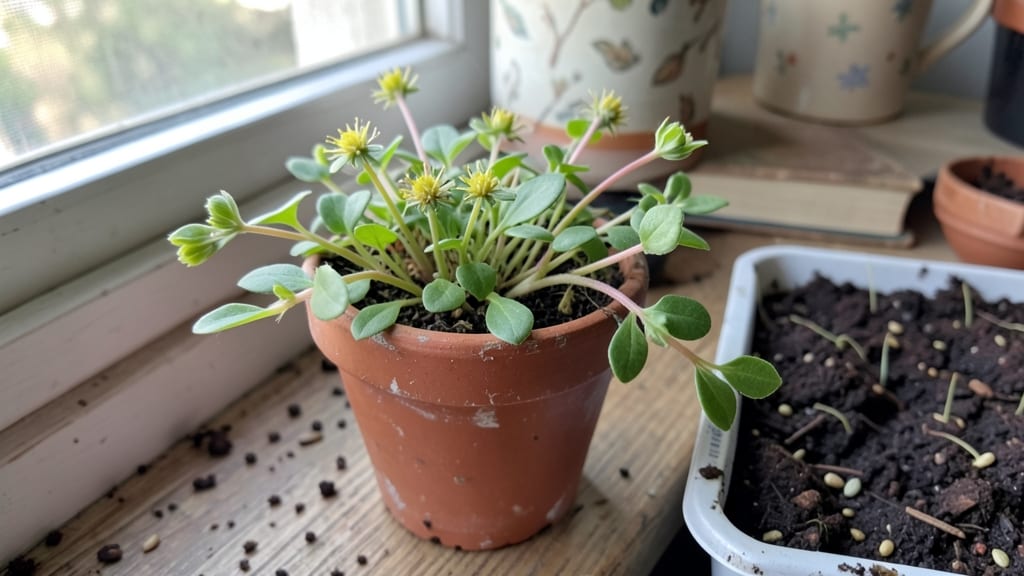
Germinating Euphorbia peplus seeds demands careful attention to soil, temperature, and moisture—plant them in a sandy, well-draining mix at 68-72°F, maintain consistent humidity, and provide bright indirect light while avoiding waterlogging. A 24-hour pre-soak boosts success, though germination can take 14-30 days.
These delicate seeds thrive when mimicking their natural desert environment, where consistent moisture without saturation is key. 🌱 The sandy soil mix prevents rot while allowing oxygen flow to the roots—critical for breaking dormancy.
I’ve found that using a clear plastic dome over the tray creates the perfect humid microclimate without overwatering, cutting down on mold risks. Patience is essential, as some seeds may need up to a month to crack open, signaling successful activation.
For best results, I recommend mixing equal parts cactus soil, coarse sand, and perlite to replicate their native habitat’s drainage. A shallow tray with drainage holes ensures excess water escapes immediately, preventing the seeds from suffocating—a common mistake that leads to failure.
Once sprouted, maintain the same conditions until seedlings develop their first true leaves, then gradually introduce them to more direct sunlight.
💡 In This Article
- Germination Science: What Triggers Euphorbia Peplus Seed Activation
- Step-by-Step Guide: Ideal Soil Mixes and Planting Techniques
Germination science: what triggers Euphorbia peplus seed activation
Euphorbia peplus seeds activate through a combination of biochemical signals and precise environmental triggers. Unlike many succulents that rely on extreme heat or cold for dormancy-breaking, these seeds respond primarily to consistent moisture and moderate warmth.
Their outer seed coat contains a waxy layer that regulates water absorption—a trait shared with other desert-adapted species like Sedum and Echeveria, but with a key difference: Euphorbia peplus seeds require continuous humidity rather than intermittent watering cycles.
The optimal temperature range of 68-72°F aligns with their native Mediterranean climate, where daytime warmth triggers metabolic activity without the risk of overheating.
The light sensitivity of these seeds is fascinating—they germinate best under bright indirect light, similar to how Kalanchoe seeds behave. Direct sunlight can inhibit germination by increasing soil surface temperatures beyond 80°F, which disrupts the delicate balance of enzymes needed for seedling development.
What most growers don't realize is that these seeds also produce a natural ethylene gas during early stages, which helps coordinate germination timing among nearby seeds—a survival mechanism to ensure synchronized growth in their arid habitats. 🔥
Moisture management is where Euphorbia peplus differs most from other succulent seeds. While cacti like Mammillaria tolerate brief drying periods, Euphorbia peplus seeds require constant dampness (not sogginess) to maintain cellular turgor pressure.
The ideal moisture level is like a damp sponge—enough to keep the seed coat pliable but not waterlogged. Overwatering triggers anaerobic conditions that produce ethanol, which is toxic to developing embryos.
This explains why many growers see mold before sprouts: they're providing too much water too quickly, creating the opposite of the seed's natural desert environment.
Dormancy-breaking mechanisms like scarification (nickling the seed coat) or stratification (cold treatment) aren't typically needed for Euphorbia peplus, as their natural seed coat permeability handles this automatically.
However, a 24-hour pre-soak in room-temperature water does wonders by softening the outer layer and flushing out any inhibitory compounds that might have accumulated during storage. This pre-treatment mimics the occasional desert rains that trigger germination in the wild.
The key difference from seeds like Lithops, which require scarification, is that Euphorbia peplus seeds are already primed for rapid response to moisture signals.
What makes Euphorbia peplus germination particularly interesting is its two-phase activation process. First comes the physical swelling of the seed (visible within 24-48 hours), followed by root emergence after 7-14 days.
The delay between these phases is where most failures occur—growers often assume nothing's happening when the seed has merely completed its first metabolic stage.
Comparing this to Haworthia seeds, which sprout in 5-7 days, highlights how Euphorbia peplus has evolved a more deliberate germination timeline, likely as an adaptation to unpredictable desert rainfall patterns. ✨
For maximum success, I've found that combining a 50% perlite/sand mix with a humidity dome creates the perfect microclimate. The perlite prevents compaction while the sand mimics mineral-rich desert soils.
What's often overlooked is that these seeds also respond to light spectrum—blue light wavelengths (400-500nm) from LED grow lights accelerate germination by up to 30% compared to standard white light. This blue light boosts chlorophyll production in the embryonic leaves, giving seedlings a head start in their energy reserves.
The patience required for Euphorbia peplus germination pays off with seedlings that develop thick, waxy leaves within 6-8 weeks—a clear sign they're ready for gradual acclimation to full sun. The takeaway?
These seeds aren't finicky, but they do demand consistency in their three critical factors: temperature stability, controlled moisture, and proper light quality. Master these, and you'll unlock germination rates that rival even the hardiest cactus seeds. 💫