Propagation
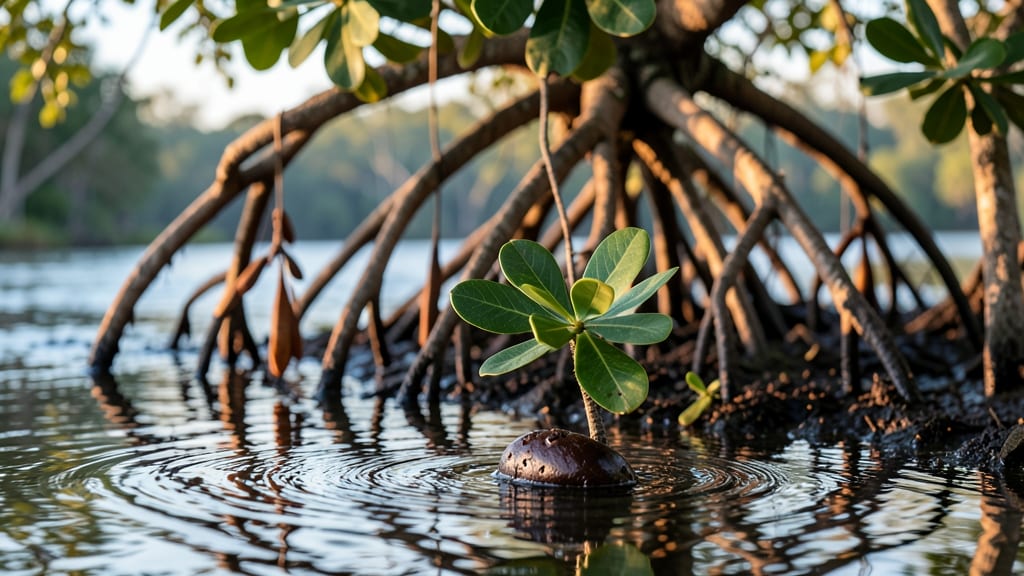
Mangrove seeds dispersal relies on water currents, buoyancy adaptations, and specialized seed structures like vivipary, where propagules grow roots before detaching to float and colonize new coastal areas.
Mangrove seeds use a clever survival strategy called vivipary, where seeds germinate while still attached to the parent plant.
These young seedlings, called propagules, develop specialized adaptations like air pockets and corky tissues that keep them buoyant. 🌊 Once they detach, ocean currents carry them far from their origin, allowing them to establish new mangrove forests along coastlines.
This process is crucial for maintaining healthy coastal ecosystems and protecting shorelines from erosion.
What makes this dispersal method so effective is how it combines biology with oceanography. The propagules can remain afloat for weeks, drifting with tides and waves until they find suitable muddy substrates to root.
Scientists study these patterns to better understand how mangroves naturally expand their range, which helps in coastal restoration projects. For example, red mangroves often produce propagules that can travel hundreds of miles before taking root, demonstrating nature's incredible adaptive strategies.
💡 In This Article
- How Vivipary and Buoyancy Enable Mangrove Seed Travel
- Optimal Conditions for Successful Mangrove Seed Germination
How vivipary and buoyancy enable mangrove seed travel
Here's what's actually happening with mangrove seeds: they use a two-stage survival system. First comes vivipary, where seeds germinate while still attached to the parent tree, developing into propagules with tiny roots.
This isn't just early germination—it's a full growth spurt while still connected, creating seedlings that can be 10-30 centimeters long before detachment. The key factor is the propagule's hydrodynamic shape, resembling a torpedo or paddle, which reduces drag and improves stability in water.
The buoyancy comes from specialized internal structures. Propagules contain aerenchyma tissue—spongy, air-filled cells that act like natural flotation devices. Some species, like the black mangrove, develop corky tissues that further increase their ability to stay afloat.
These adaptations allow propagules to remain viable for up to 6 months while drifting, a remarkable feat considering they're essentially living seeds. The science behind this involves negative buoyancy control: as the propagule ages, it gradually loses buoyancy, ensuring it eventually sinks near suitable substrates.
What most people don't realize is how this system interacts with ocean currents. Propagules typically detach during high tides when water levels are highest, giving them the best chance to catch currents.
The 1-3 millimeter thick outer layer of some propagules contains waxy coatings that repel water, further enhancing their floating ability. This combination of biological adaptations and physical oceanography creates what scientists call "dispersal windows"—specific times and conditions where propagules have optimal chances to travel long distances before establishing new colonies.
Consider these key factors when examining mangrove dispersal patterns:
- Propagule density: Red mangroves produce propagules with densities of 0.8-0.9 g/cm³, making them nearly neutrally buoyant
- Current interaction: Propagules can travel 100+ kilometers in favorable conditions, with some studies tracking movements of 300+ kilometers
- Root development: Propagules develop specialized anchor roots that can penetrate substrates within 24-48 hours of contact
The most fascinating aspect is how propagules maintain viability during their journey. Some species enter a dormancy-like state when conditions aren't ideal, only resuming growth when they encounter suitable substrates. This adaptive strategy explains why mangroves can colonize new areas so effectively—even after traveling vast distances.
The process works because these seeds aren't just passive passengers; they're actively preparing for establishment the moment they detach from their parent plant.
What makes this even more remarkable is the ecological impact. These drifting propagules often become the primary means of mangrove expansion, especially in areas where human activity has fragmented natural forests. For example, after Hurricane Katrina, mangrove propagules from distant areas helped restore coastal wetlands along the Gulf Coast.
This natural dispersal mechanism demonstrates how mangroves maintain genetic diversity while expanding their range—all thanks to their clever combination of vivipary and hydrodynamic adaptations.
Here's the takeaway: mangrove seed dispersal isn't just about floating—it's a sophisticated biological engineering feat that combines plant development, fluid dynamics, and ecological strategy. The result is one of nature's most effective coastal colonization systems. 🌊