Trees
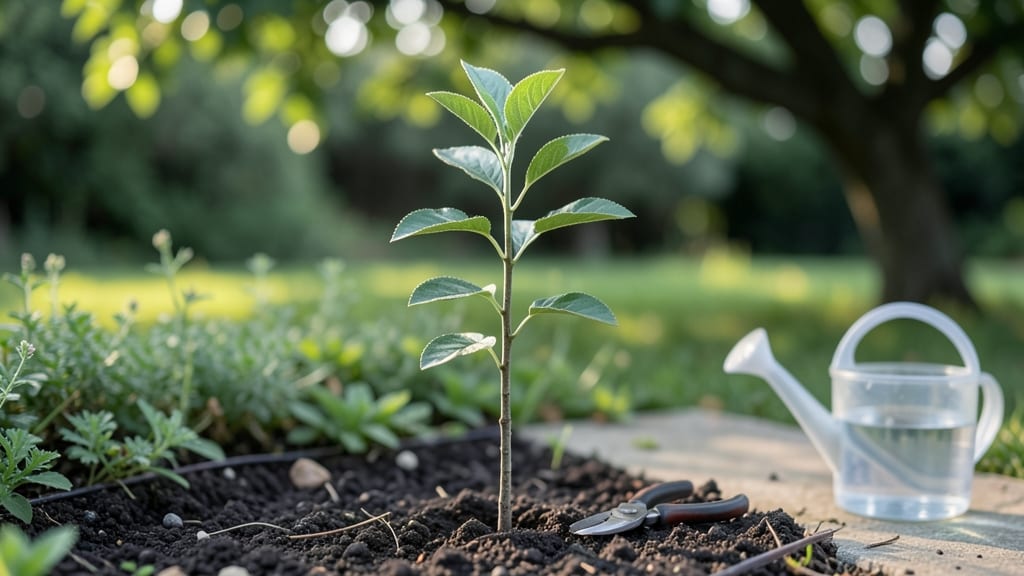
Apple tree seedling leaves are typically smaller, thinner, and more rounded than mature tree leaves, with a lighter green hue and fewer serrations along the edges. They often appear softer and more delicate due to the tree’s early growth stage.
Those early-stage leaves are a fascinating study in plant development. 🌱 The tiny, tender foliage reflects the seedling's focus on establishing roots and stems before investing energy in larger leaves.
Young apple trees prioritize rapid growth over leaf complexity, which is why their edges stay smooth and their color leans toward pale green—this helps maximize sunlight absorption during their critical first years.
Over time, as the tree matures, its leaves gradually develop deeper veins, sharper serrations, and a richer green pigment as the plant shifts its energy toward fruit production and structural support.
This transformation isn't just about aesthetics—it's a survival strategy. Seedlings need to balance growth with resource conservation, while mature trees can afford the "luxury" of larger leaves that improve photosynthesis efficiency.
The shift typically becomes noticeable in the tree's third to fifth year, when you'll start seeing those classic apple tree leaf shapes with their distinctive jagged edges and thicker texture.
💡 In This Article
- How Apple Tree Seedling Leaves Develop Over Time
- Identifying Healthy vs Unhealthy Seedling Leaves
How apple tree seedling leaves develop over time
The transformation of apple tree foliage begins at the cellular level, where meristematic cells in the shoot tips divide rapidly during early growth. These young leaves emerge with simpler structures because the seedling's energy is directed toward establishing vascular systems and root networks rather than complex leaf architecture.
The initial leaves often measure just 1-3 centimeters in length, with smooth edges that maximize surface area for light absorption in their delicate state.
As the seedling matures, chlorophyll production intensifies, shifting the leaf color from pale green to the darker, richer green seen in mature trees. This change occurs because older leaves develop more chloroplasts—up to 500,000 per square millimeter—while seedlings have only about 200,000 per square millimeter.
Sunlight exposure plays a crucial role: seedlings in full sun develop slightly thicker leaves with more pronounced veins as a protective adaptation, while shaded seedlings remain thinner and lighter.
The development of serrations—those jagged edges—is a fascinating process tied to auxin hormone distribution. In mature trees, auxin accumulates at the leaf margins, promoting cell elongation that creates the characteristic saw-tooth pattern.
Seedlings lack this hormonal specialization, so their edges stay smooth. This structural simplification helps conserve water and nutrients during the seedling's vulnerable growth phase.
Nutrient availability dramatically affects leaf texture and durability. Young apple trees growing in nitrogen-rich soil develop leaves that are softer and more prone to damage, while those in balanced soil with adequate phosphorus and potassium produce sturdier foliage.
The leaf thickness typically increases from 0.1 millimeters in seedlings to 0.3-0.5 millimeters in mature trees, reflecting the plant's increasing ability to transport water and nutrients through more developed vascular bundles.
Here's what's happening biologically: The transition from seedling to mature leaves involves three key developmental stages. First comes the primordium stage where basic leaf shapes form. Then the expansion phase where cells divide rapidly.
Finally, the maturation phase where chlorophyll fully develops and leaf structures specialize. This process can take 4-8 weeks per leaf set, depending on environmental conditions.
The most dramatic changes occur during the tree's first five years, when leaf size can increase by up to 300% and serration depth becomes pronounced. This growth spurt coincides with the tree's shift from vegetative growth to reproductive maturity, where larger leaves become essential for supporting fruit development.
The final leaf structure represents an optimal balance between photosynthesis efficiency and structural integrity—something seedlings simply can't achieve yet.